
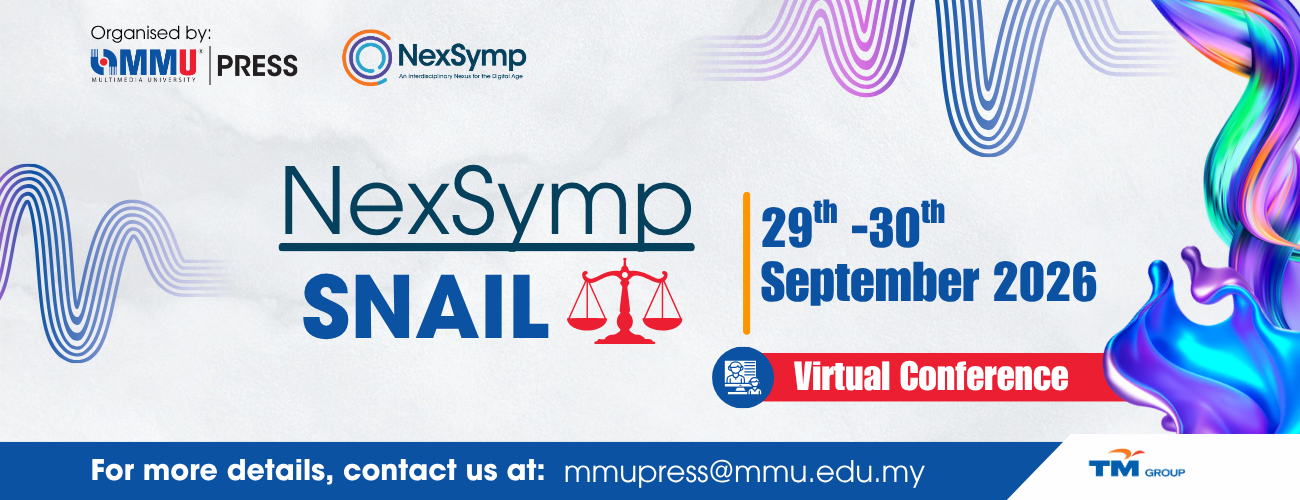
NexSymp: SNAIL 2026
1st Symposium on Navigating Artificial Intelligence and Law
Theme
Generative AI, Agents and the Law
Venue
29–30 Sep 2026: Online
Call for Papers
We are pleased to announce NexSymp: SNAIL 2026, the 1st Symposium on Navigating Artificial Intelligence and Law (SNAIL). This symposium brings together researchers, practitioners, policymakers, and educators to advance the intersection of artificial intelligence and legal practice, theory, and governance. We invite high-quality, original contributions that address the broad spectrum of AI and law, from foundational theory to practical applications and policy implications.
Topics of Interest
We welcome papers spanning the following and related domains (not limited to):
1. Legal Reasoning and AI
- Automated reasoning for legal systems
- Case-based reasoning and argumentation in law
- Formalization of legal knowledge and ontologies
- Interpretability and transparency in legal AI
2. AI for Legal Practice
- AI-assisted contract analysis and drafting
- Compliance monitoring and regulatory tech
- E-discovery and evidence automation
- Intellectual property analytics and enforcement
3. Data, Privacy, and Security
- Privacy-preserving machine learning for legal data
- Data governance, stewardship, and bias mitigation in legal AI
- Security of AI systems in judiciary and administration
4. Public Policy, Regulation, and Ethics
- Accountability frameworks for AI in law
- AI governance, risk management, and oversight
- Fairness, bias, and discrimination in legal AI
- Impact of AI on access to justice
5. Judicial Automation and Administration
- AI in courts and tribunal
- Sentence prediction, risk assessment, and fairness considerations
- Administrative AI for case management and workflow optimization
6. Human-AI Collaboration in Legal Contexts
- Decision support vs. automation in legal practice
- User interfaces and usability for legal professionals
- Adoption challenges and change management
7. AI and Legal Education
- Teaching AI literacy in law schools
- Curriculum design and case studies on AI and law
- Ethical and professional responsibility education for AI in law
8. Multidisciplinary and Domain-Specific Applications
- AI for regulatory compliance across industries (finance, healthcare, energy, etc.)
- AI for international law and cross-border enforcement
- Tech-enabled dispute resolution and arbitration
Who Should Attend?
- Academics and researchers
- Undergraduate and postgraduate students
- Practitioners in the legal profession
Important Dates
|
Description |
Deadline |
|
Full paper submission deadline |
|
|
Paper acceptance notification |
15 August 2026 |
|
Camera ready submission |
24 August 2026 |
|
Registration deadline |
|
| Symposium date |
29–30 September 2026 |
REGISTRATION FEES AND PAYMENT INFO
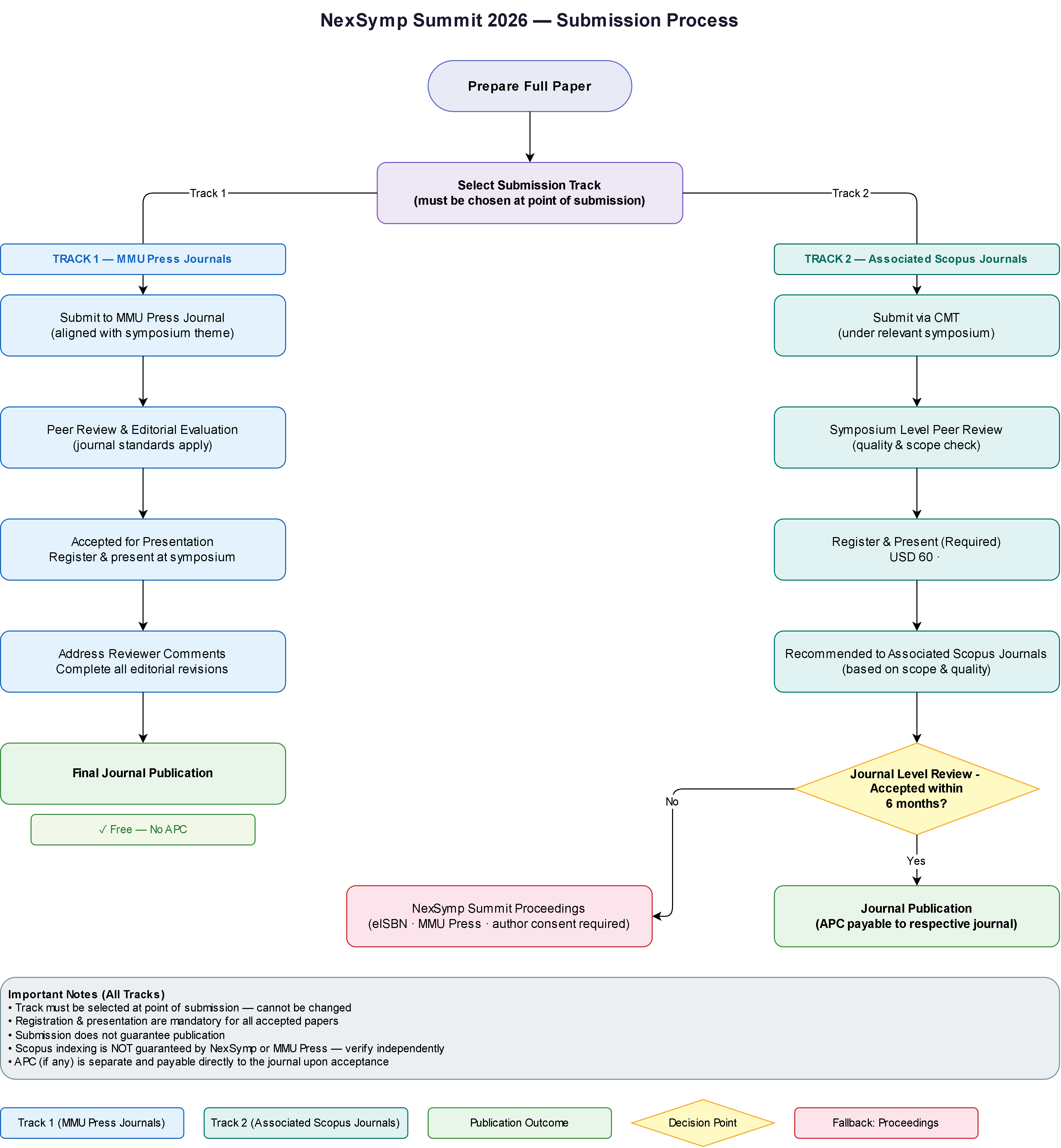
Registration and presentation at NexSymp Summit 2026 are required for all accepted papers to proceed with publication consideration.
Fee Structure
|
Tracks |
Registration Fees (excl. APCs) |
| Track 1: MMU Press Journals | Free |
| Track 2: Associated Journals (Scopus) | If you require an invoice, please fill up this form |
What the Registration Fee Covers
- Conference participation
- Presentation of accepted paper
- Access to the selected submission tracks
Important Fee Notes
- Registration fee covers symposium participation only.
- APC/Publication fees (if applicable) is separate from the registration fee and payable directly by the authors to the respective journal upon acceptance.
- Each accepted paper requires at least one registered author.
- Non-registration or non-presentation may result in withdrawal from publication consideration.
Publication Channels
All accepted papers will be published in:
- Asian Journal of Law and Policy (MyCite-indexed) (Articles accepted will be published in the November 2026 issue)
- Associated Scopus-indexed journals:
- NexSymp Summit Proceedings (by MMU Press with eISBN)
Full Paper Submission
| Track 1: MMU Press Journals | Track 2: Associated Scopus Journals |
|---|---|
|
Associated Scopus-indexed Journals:
*Additional associated journals may be added periodically. |
 |
 |
Authors who have submitted a new paper via OJS or CMT are required to complete the Paper Submission Form here: Paper Submission Form
Publication Notes
- All submissions are subject to peer review and editorial decision.
- Acceptance for presentation does not guarantee final journal publication as it is subject to authors completing all required revisions and editorial requirements.
- Final publication decisions rest with the respective journal editors.
- APC/Publication fees (if applicable) are separate from the NexSymp registration fee and payable directly by the authors to the respective journals/publishers upon acceptance. Publication fees and arrangements may vary depending on the respective journal’s review, editorial, and publication procedures under the symposium collaboration arrangement.
- Important: While Track 2 provides access to journals that are currently Scopus-indexed, Scopus indexing is not guaranteed by NexSymp Summit 2026 or MMU Press. Indexing status is determined solely by the respective journals and indexing bodies, and may change at any time. Authors are advised to verify a journal’s current indexing status independently before submission.
- Papers not selected for associated Scopus-indexed journals may be considered for the NexSymp Summit Proceedings (eISBN) published by MMU Press, subject to editorial review and quality requirements.
| Track 1: MMU Press Journals | Track 2: Associated Journals (Scopus) | |
|---|---|---|
| Registration fee | Free | USD 60 |
| APC/ Publication fees | None | May apply (payable to the journal) |
| Submission system | Direct submission to MMU Press journals (OJS) | CMT |
| Publication scope | MMU Press journals | Associated Scopus-indexed journals |
| Fallback if not published | Not applicable | NexSymp Summit Proceedings (eISBN) |
Organising Committee
Chair: Assoc. Prof. Dr. Dennis W. K. Khong (Multimedia University, Malaysia)
Co-Chair: Asst. Prof. Dr. Olivia Tan Swee Leng (Multimedia University, Malaysia)
Track Chairs:
- Track 1: Dr. Eliya Hamizah Binti Hamzah (Multimedia University, Malaysia)
- Track 2: Asst. Prof. Dr. Olivia Tan Swee Leng (Multimedia University, Malaysia)
Collaboration and Publicity Chair: Dr. Yusnita Mohd Yusof (Multimedia University, Malaysia)
Technical Chair: Ms. Shahrina Anis Binti Samsudin (Multimedia University, Malaysia), Dr. Shereen Khan (Multimedia University, Malaysia)
Publication Chair: Dr. Dennis W. K. Khong (Multimedia University, Malaysia)
Logistics Chair: Ms. Shahrina Anis Binti Samsudin (Multimedia University, Malaysia)
Technical Program Committee:
- Prof. Salawati Mat Bashir (Universiti Kebangsaan Malaysia, Malaysia)
- Dr. K.R. Sowmya (SRM Valliammai Engineering College, India)
- Dr. Rossanne Gale Vergara (Association of Innovative Educational Research, Malaysia)
- Prof. Dr. Suresh Ponnan (Vel-Tec, India)
KEYNOTE SPEAKERS

Professor Subhajit Basu
Professor
University of Leeds School of Law
Professor Subhajit Basu is Professor of Law and Technology at the University of Leeds School of Law. His research examines how digital technologies, big data and artificial intelligence reshape law, governance and society, with particular attention to emerging technologies, cyberspace, health data, autonomous systems, online harms, privacy, data protection, freedom of expression and the Global South. He has an international reputation for interdisciplinary work on the legal, regulatory and ethical implications of digital transformation, including the power of data-driven and AI-enabled systems to influence decision-making, autonomy, accountability and social justice. Professor Basu is Editor-in-Chief of the International Review of Law, Computers & Technology and has served as Chair of the British and Irish Law Education Technology Association. He has led and contributed to major externally funded projects on cybercrime, autonomous vehicles, responsible AI, healthcare data and online sexual exploitation. His books include Global Perspectives on E-Commerce Taxation Law and, as co-author, Privacy and Healthcare Data: ‘Choice of Control’ to ‘Choice’ and ‘Control’. He regularly advises, trains and engages with policymakers, governments, international organisations and academic institutions, particularly on technology regulation and digital governance. His scholarship asks how law can protect dignity, trust and human flourishing while enabling responsible innovation across societies.
INVITED SPEAKERS

Dr. May Fong Cheong
Associate Professor
School of Private and Commercial Law, Faculty of Law and Justice, UNSW Sydney, Australia
Dr. Cheong is a comparative law scholar specialising in Asian jurisdictions, whose cutting-edge research investigates the intersection of law, emerging technology, and artificial intelligence. Specifically, she examines how digital innovations and smart contracts reshape traditional contract paradigms and consumer protection frameworks. Her distinguished academic career features prominent leadership positions, having previously served as Professor and Dean of the Faculty of Law at the University of Malaya, and Deputy Head of School at the Australian Catholic University. Drawing upon her early experience as a commercial litigator, May is a prolific author, contributing foundational texts and peer-reviewed articles on commercial, competition, and contract law to prestigious international university presses and journals.
Collaborators:

CMT Acknowledgement
The Microsoft CMT service was used for managing the peer-reviewing process for this conference. This service was provided for free by Microsoft and they bore all expenses, including costs for Azure cloud services as well as for software development and support.