
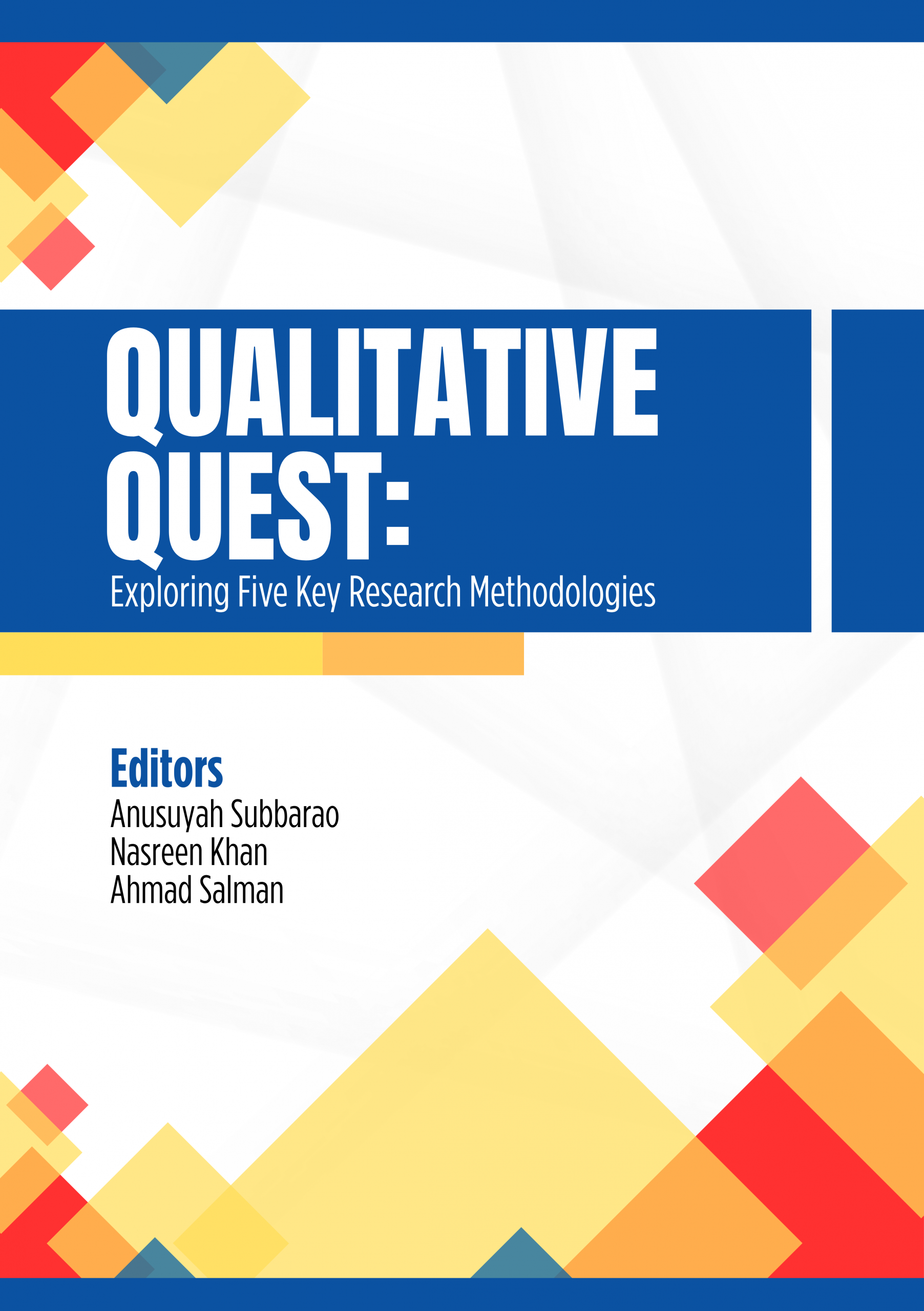
Qualitative Quest: Exploring Five Key Research Methodologies
“Qualitative Quest serves as your comprehensive guide through five powerful research methodologies that shape how we investigate human experience and social phenomena. This essential resource demystifies Action Research, Phenomenology, Ethnography, Case Study, and Grounded Theory-taking readers from theoretical foundations to practical application. Whether you’re a graduate student beginning your research journey or an experienced practitioner expanding your methodological toolkit, this book provides the clarity and depth you need. Each methodology is explored through its philosophical underpinnings, distinctive characteristics, and real-world applications. Discover how Action Research transforms communities through participatory inquiry, how Phenomenology unveils lived experience, how Ethnography reveals cultural patterns, how Case Study methodology provides contextual understanding, and how Grounded Theory builds theoretical frameworks. Featuring practical examples, step-by-step guidance, and critical considerations, Qualitative Quest bridges methodological theory and research practice. The book addresses common challenges, offers strategies for ensuring rigor, and provides frameworks for selecting appropriate methodologies. More than a methods handbook, this is a journey through qualitative inquiry-empowering researchers to make informed choices that honor their research questions and humancomplexity.
Perfect for: Graduate students, researchers, evaluators, consultants, and anyone exploring qualitative methodologies.
Cite this book as:
Subbarao, A., Khan, N., & Salman, A. (2026). Qualitative quest: Exploring five key research methodologies. MMU Press.
Table of Contents:
Chapter 1
Transformative Action Research: Bridging Theory and Practice for Sustainable Change
By Olivia Tan Swee Leng and Rossanne Gale Vergara
Abstract – This chapter presents an examination of Transformative Action Research (TAR) as a potential bridge between academic inquiry and working towards sustainability. TAR considers participatory, ethical, and adaptive approaches to inquiry that engage researchers and practitioners alike, closely aligning with Environmental, Social, and Governance (ESG) principles and supporting shifts and changes in systems. This chapter works through the important literature to demonstrate how TAR has enabled the coupling of academic theory and practical action in responding to sustainability issues. The chapter then goes further to examine the foundations for TAR as a theoretical construct, and its connection and partnership with ESG values as a permissible vector towards achieving meaningful, context responsive transformations across domains. Thus, the chapter leverages TAR as a dynamic framework for achieving ESG dividends and outcomes within academic and practical environments.
Cite this chapter as:Tan, O. S. L., & Vergara, R. G. (2026). Transformative action research: Bridging theory and practice for sustainable change. In A. Subbarao, N. Khan, & A. Salman (Eds.), Qualitative quest: Exploring five key research methodologies (pp. 7–32). MMU Press.
Chapter 2
Lived Experiences of Workers Displaced by Artificial Intelligence Adoption
By Kyra Law Ley Sy and Kelly Tee Pei Leng
Abstract – This qualitative research study explores employees’ experiences of working in Malaysia and Singapore during the adoption of artificial intelligence (AI) systems. Analysing comments on social media platforms is an innovative approach. The discussions took place in Facebook groups, where individuals shared genuine experiences regarding the adoption of AI in workplaces. Diverse commenters were selected to ensure a wide range of perspectives and experiences. The focus is to understand current trends in AI adoption by applying a qualitative sentiment approach that involves setting aside researcher assumptions. This method identifies key themes in the data and extracts core insights from user experiences. The sentiment analysis reveals three significant findings. The primary theme is that users focus on how automation may replace human jobs and lead to unemployment. The second theme involves personal development and responsibility, where individuals bear the burden of adapting to AI-related changes. The third finding reveals that AI serves as a platform for individuals to critique general workplace issues. The research demonstrates individuals’ experiences with AI adoption. The findings also reveal that individuals engage in reflective thinking, connecting personal AI experiences to larger societal and economic concerns. These findings offer important insights into individuals’ perspectives on technological change, which may guide the development of more effective AI adoption strategies.
Cite this chapter as: Law, K. L. S., & Tee, K. P. L. (2026). Lived experiences of workers displaced by artificial intelligence adoption. In A. Subbarao, N. Khan, & A. Salman (Eds.), Qualitative quest: Exploring five key research methodologies (pp. 33–46). MMU Press.
Ethnography as a Path to Understanding Human Experience
By Anusuyah Subbarao and Premylla Jeremiah
Abstract – This ethnographic study explores the lived experiences of Dr. Sarah Martinez, a mid-career academic navigating the increasingly complex demands of contemporary university life. Drawing on eighteen months of participant observation and narrative interviews, I examine how institutional pressures fragment academic identity and reshape the meaning of scholarly work (Berg & Seeber, 2016). Sarah’s story reveals the hidden costs of academic labour in an era of budget constraints, technological disruption, and administrative expansion. Her daily negotiations between teaching obligations, research aspirations, and bureaucratic demands illuminate broader questions about the sustainability of academic careers and the transformation of higher education as a site of knowledge production (Ylijoki & Ursin, 2013).
Cite this chapter as: Subbarao, A., & Jeremiah, P. (2026). Ethnography as a path to understanding human experience. In A. Subbarao, N. Khan, & A. Salman (Eds.), Qualitative quest: Exploring five key research methodologies (pp. 47–84). MMU Press.
Chapter 4
In-depth Inquiry: Understanding and Applying the Case Study Method
By Abdul Aziz Ahmad
Abstract – This chapter explores the case study method as a robust and versatile research approach, widely used across disciplines to investigate complex phenomena within their real-life contexts. The chapter provides an overview of the theoretical foundations of the case study method, detailing its origins, key characteristics, and application in qualitative research. By highlighting various types of case studies, such as exploratory, descriptive, and explanatory, the chapter emphasizes the method’s flexibility in addressing a range of research questions. Drawing from examples in the field of business and management, it demonstrates how case studies enable in-depth exploration and offer practical insights into specific issues or processes. Additionally, the chapter discusses the strengths and limitations of the case study method, providing guidance on designing, collecting data, and analysing case studies effectively. Finally, it offers recommendations for researchers on how to leverage case studies to generate meaningful findings and contribute to theory-building and policymaking.
Cite this chapter as: Ahmad, A. A. (2026). In-depth inquiry: Understanding and applying the case study method. In A. Subbarao, N. Khan, & A. Salman (Eds.), Qualitative quest: Exploring five key research methodologies (pp. 85–98). MMU Press.
Chapter 5
A Methodological Investigation of Grounded Theory Studies
By Muhammad Afif Fathullah and Anusuyah Subbarao
Abstract – Grounded theory is a research design defined as a process for a researcher to construct a theory that explains a process, an action, or an interaction. There have been extensive articles on the empirical results of grounded theory throughout the literature; however, to the best of our knowledge there has been limited discussion with regard to the experience and reflection of a researcher who has done a grounded theory study. As such, the purpose of this article is to share our reflections on the challenges, benefits, and opportunities that we faced when conducting grounded theory research. The article will first explain the chronological evolution of grounded theory from its inception in 1967 to the present. After that, reflections on our cases, case 1: “Digital Transformation: Navigating Complexities of Global Software Development” and Case 2: “Cybersecurity: Risk Indicators for Cloud Computing Risk Analysis” are presented. The cases presented express our perspectives and our points of view in using grounded theory for our study which reflects on the challenges, benefits, and opportunities we faced. We identified and discussed the challenges, benefits, and opportunities of grounded theory design. Lastly, we conclude with several recommendations for future research, and we hope that this article is able to illuminate and empower researchers who are interested in grounded theory research to pursue and excel in it.
Cite this chapter as: Fathullah, M. A., & Subbarao, A. (2026). A methodological investigation of grounded theory studies. In A. Subbarao, N. Khan, & A. Salman (Eds.), Qualitative quest: Exploring five key research methodologies (pp. 99–120). MMU Press.
Chapter 6
Conclusion: Choosing Your Path: A Comparative Synthesis of Five Qualitative Methodologies
By Anusuyah Subbarao, Nasreen Khan and Ahmad Salman
Abstract – The five methodologies explored in this volume, namely Transformative Action Research, Phenomenology, Ethnography, Case Study, and Grounded Theory, represent the breadth and depth of contemporary qualitative inquiry. Each has been presented on its own terms, with its own philosophical foundations, procedural logic, and applied examples. This concluding chapter steps back from those individual treatments to offer a comparative synthesis, by drawing the methodologies into dialogue with one another. The purpose is not to rank or reduce them, but to equip researchers with a clear sense of how to choose among them, and how understanding one methodology more fully illuminates the others.
Cite this chapter as: Subbarao, A., Khan, N., & Salman, A. (2026). Conclusion: Choosing your path: A comparative synthesis of five qualitative methodologies. In A. Subbarao, N. Khan, & A. Salman (Eds.), Qualitative quest: Exploring five key research methodologies (pp. 121–130). MMU Press.
Back