

NexSymp: 1st International Symposium on Business, Social Sciences, and Communication (BIZSCOM 2026)
Leveraging Artificial Intelligence in Business, Social Science, and Communication for a Sustainable Future
The 1st International Symposium on Business, Social Sciences, and Communication (BIZSCOM 2026) invites scholars, researchers, practitioners, and industry experts to submit original research papers and participate in an interdisciplinary platform that explores the transformative role of Artificial Intelligence (AI) in shaping a sustainable future.
As AI technologies continue to redefine industries, societies, and communication landscapes, this symposium aims to critically examine both the opportunities and challenges of integrating AI across diverse domains. BIZSCOM 2026 provides a space for meaningful dialogue, knowledge exchange, and collaboration among academics and professionals worldwide.
Conference Theme Overview
The theme emphasizes the strategic use of AI to enhance innovation, decision-making, and sustainability in business practices, social development, and communication processes. Contributions are encouraged to explore how AI-driven solutions can address real-world problems while promoting ethical, inclusive, and sustainable outcomes.
Topics of Interest
Submissions are welcome in (but not limited to) the following areas:
Business and Management
- AI in strategic management and decision-making
- Digital transformation and intelligent enterprises
- AI-driven marketing, branding, and consumer analytics
- Financial technology (FinTech) and AI applications
- Supply chain optimization and smart operations
- Entrepreneurship, innovation, and AI ecosystems
- Sustainable business models and green innovation
- Big data analytics and business intelligence
- Risk management, governance, and AI integration
- Human resource management and AI in the workplace
Social Sciences
- AI and societal impact
- Ethics, governance, and policy in AI
- Human-AI interaction and behavioural studies
- AI in education and learning systems
- Social sustainability and inclusive technologies
- AI and cultural transformation in society
- Cross-cultural studies in AI adoption and use
- Preservation and evolution of culture through AI technologies
- AI in language studies, linguistics, and translation
- Natural language processing (NLP) and communication practices
- Multilingual communication in AI-driven environments
- Psychological impacts of AI on individuals and communities
- Human cognition, perception, and AI interaction
- AI in mental health research and interventions
- Behavioural change and technology acceptance in AI contexts
Communication Studies
- AI in media, journalism, and content creation
- Digital communication and social media analytics
- Misinformation, disinformation, and AI moderation
- Trust, credibility, and ethics in AI-mediated communication
- Intercultural communication in the digital age
- AI in public relations and strategic communication
- Audience engagement and personalization through AI
- Visual communication and AI-generated content
- Crisis communication in AI-driven environments
- Communication technologies and digital storytelling
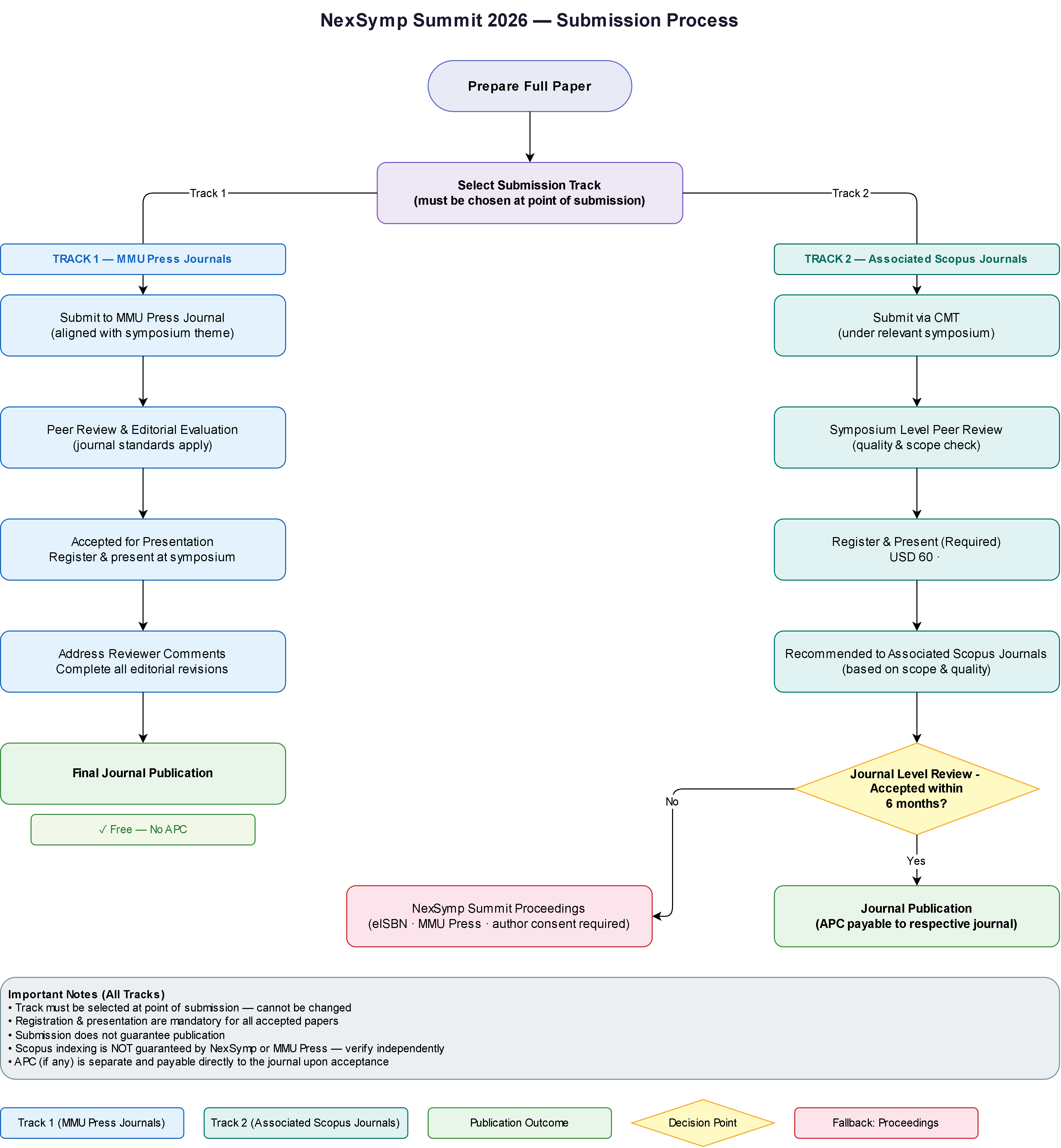
Submission and Publication
| Track 1: MMU Press Journals (Registration fee: Free) |
Track 2: Associated Journals (Scopus) (Registration fee: USD60) |
|---|---|
| • Pathway to publication in MMU Press journals. • Free (No APC).   Business and Management Business and Management
Submission via International Journal of Management, Finance and Accounting (IJOMFA) ISSN: 2735-1009 Social Sciences Submission via Issues and Perspectives in Business and Social Sciences (IPBSS) ISSN: 2785-9266 Communication Studies Submission via Journal of Communication, Language and Culture (JCLC) ISSN: 2805-444X Paper Submission Guidelines (OJS Manual):
|
• Publication via Associated Scopus-indexed journals. • APC/Publication fees payable directly to the journal upon acceptances. Paper Submission Guidelines:
Associated Scopus-indexed Journals*:
*Additional associated journals may be added periodically. |
Authors who have submitted a new paper via OJS or CMT are required to complete the Paper Submission Form here: Paper Submission Form
Publication Notes
- All submissions are subject to peer review and editorial decision.
- Acceptance for presentation does not guarantee final journal publication as it is subject to authors completing all required revisions and editorial requirements.
- Final publication decisions rest with the respective journal editors.
- APC/Publication fees (if applicable) are separate from the NexSymp registration fee and payable directly by the authors to the respective journals/publishers upon acceptance. Publication fees and arrangements may vary depending on the respective journal’s review, editorial, and publication procedures under the symposium collaboration arrangement.
- Important: While Track 2 provides access to journals that are currently Scopus-indexed, Scopus indexing is not guaranteed by NexSymp Summit 2026 or MMU Press. Indexing status is determined solely by the respective journals and indexing bodies, and may change at any time. Authors are advised to verify a journal’s current indexing status independently before submission.
- Papers not selected for associated Scopus-indexed journals may be considered for the NexSymp Summit Proceedings (eISBN) published by MMU Press, subject to editorial review and quality requirements.
| Track 1: MMU Press Journals | Track 2: Associated Journals (Scopus) | |
|---|---|---|
| Registration fee | Free | USD 60 |
| APC/ Publication fees | None | May apply (payable to the journal) |
| Submission system | Direct submission to MMU Press journals (OJS) | CMT |
| Publication scope | MMU Press journals | Associated Scopus-indexed journals |
| Fallback if not published | Not applicable | NexSymp Summit Proceedings (eISBN) |
KEYNOTE SPEAKERS
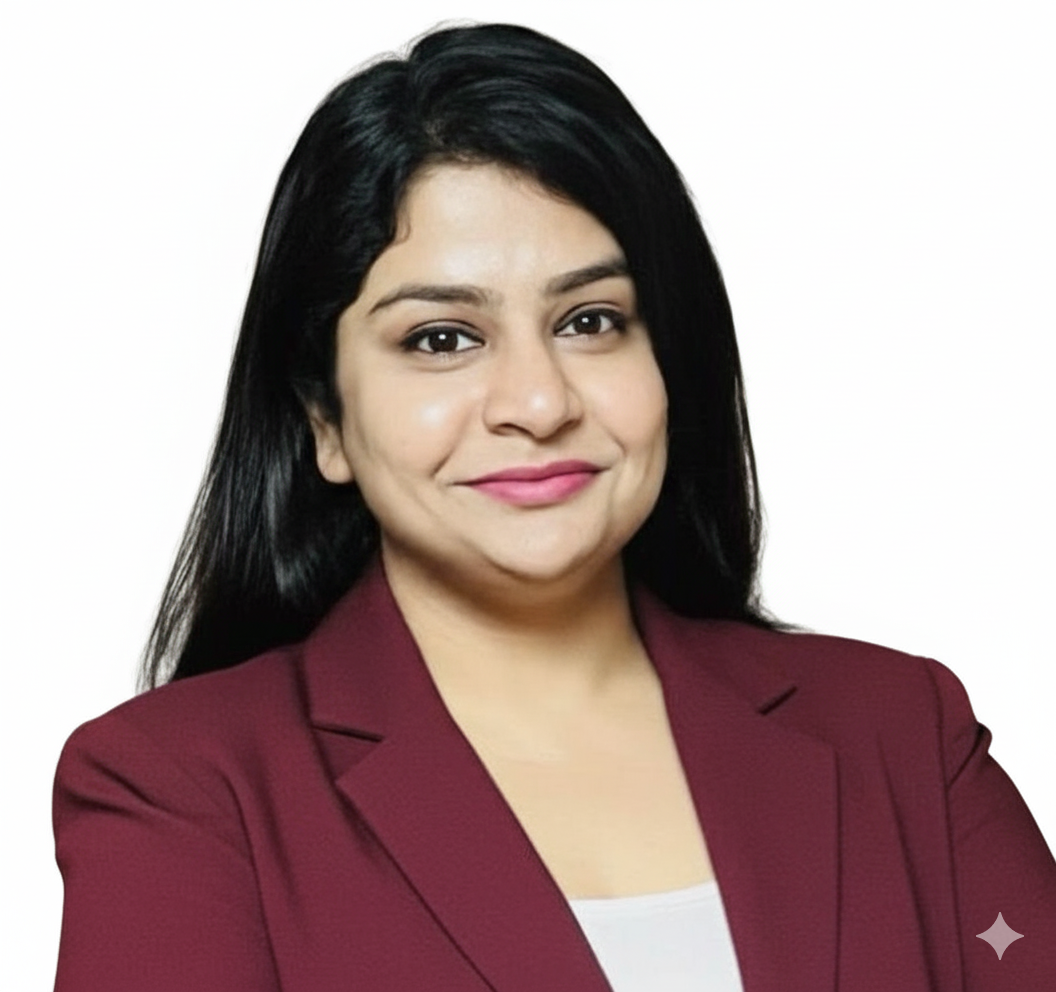
Assoc. Prof. Dr. Vedika Gupta
Associate Professor and Assistant Dean
O.P. Jindal Global University, India
Dr. Vedika Gupta is an Associate Professor in Information Systems and Analytics at O.P. Jindal Global University, with research centered on social media analytics, natural language processing, and AI-driven sentiment and emotion analysis. Her work focuses on extracting meaningful insights from unstructured data, particularly in low-resource and multilingual contexts. She holds a Ph.D. in Computer Science from National Institute of Technology Delhi, where her doctoral research advanced linguistic approaches for sentiment analysis of social media data. Over the years, she has built a strong interdisciplinary research portfolio spanning computational linguistics, information retrieval, and applied machine learning. Dr. Gupta has authored 60+ peer-reviewed publications in leading journals and conferences, including ACM, IEEE, Springer, Elsevier, and Cambridge University Press. Her contributions include work on hate speech detection, multilingual NLP, fake news detection, and AI applications in healthcare, finance, and social systems. She also serves as a reviewer for top-tier journals and has evaluated over 200 research papers. In addition to research, she plays active academic leadership roles, including Assistant Dean for MBA programs and Guest Editor for multiple international journals and special sessions. She has led conferences, organized academic events, and contributed to curriculum development through industry-aligned MOOCs in artificial intelligence, database systems, and natural language processing. Her work bridges academia and practice, with a sustained focus on developing scalable AI solutions for real-world societal challenges, particularly in the domains of digital behavior, online safety, and computational social science.
INVITED SPEAKERS

Nur Indah Sukir
Program Lead – Psychology
Manipal University College Malaysia
Nur Indah is an academic and researcher in the field of psychology with a strong focus on teaching, student development, and educational research. She serves within the Faculty of Allied Health and Psychology and is actively involved in curriculum development, programme accreditation, and interdisciplinary collaboration across psychology, physiotherapy, occupational therapy, and other health-related disciplines. Her academic interests include lifelong learning, metacognitive awareness, self-efficacy, and student development among undergraduate learners in Malaysia. As an Educational Psychologist and psychology educator, she teaches courses such as adolescent psychology and educational psychology, while emphasizing hands-on learning, community engagement, and student-centred learning approaches. Currently pursuing a Doctor of Education (EdD), her doctoral research examines predictors of attitudes toward lifelong learning among undergraduate students in Malaysia. Her work also explores the role of emerging technologies and artificial intelligence in transforming education, communication, and human development, with particular interest in how innovative digital solutions can support meaningful societal impact and responsible educational practices. Beyond research and teaching, she is actively involved in academic leadership activities including ethics review processes, programme promotion initiatives, community projects, workshop facilitation, and interdisciplinary educational engagement. Known for combining academic rigor with creativity in teaching and outreach, Nur Indah is passionate about bridging psychology, education, and innovation to address contemporary challenges in society and academia.
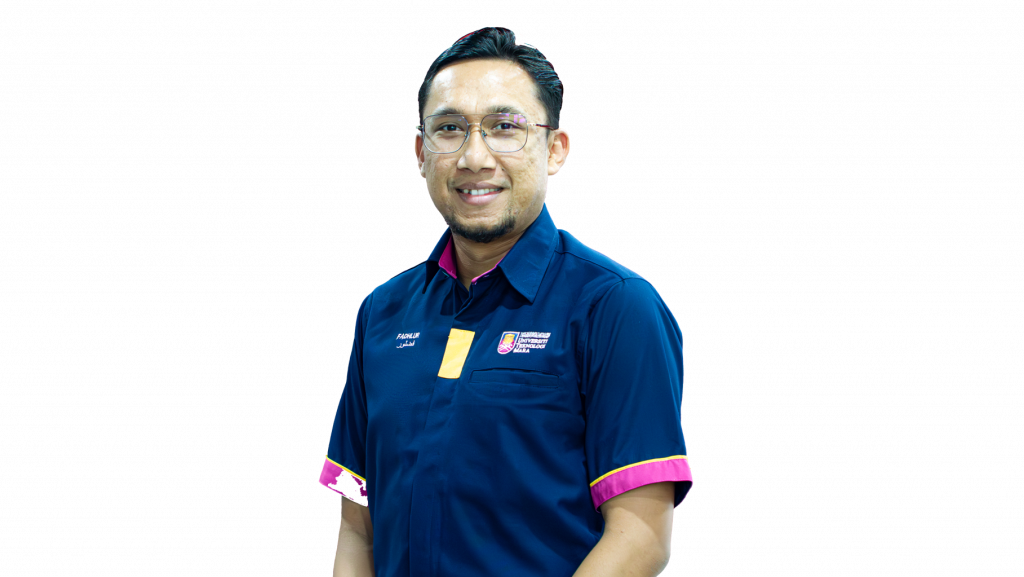
Dr Fadhlur Rahim bin Azmi
Senior Lecturer
Universiti Teknologi MARA, Cawangan Melaka
Dr. Fadhlur Rahim Azmi is a Senior Lecturer at the Department of Management and Marketing, Faculty of Business and Management, Universiti Teknologi MARA (UiTM), Melaka. He holds a PhD and Master of Science in Technology Management from Universiti Teknikal Malaysia Melaka, and a Bachelor of Business Administration (Hons.) in Marketing from UiTM. His areas of expertise include supply chain risk management, supply chain resilience, marketing, operations management, and sustainability development. He is currently serving as Coordinator for Conferences, Seminars, and Journals under Research and Industrial Linkages (PJI), UiTM Melaka, and previously contributed as a Subject Matter Expert with the Technology Depository Agency under the Ministry of Finance Malaysia, where he was involved in analysing technology transfer impact and developing impact assessment frameworks for industry collaboration programmes.
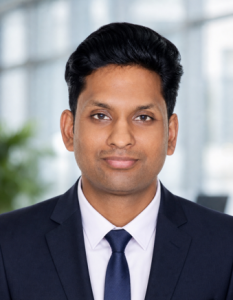
AP Dr. Arun Aggarwal
Associate Professor
Chitkara University, India
An experienced academic with over 12 years of teaching, research, and academic leadership in human resource management, organizational behaviour, and research methodology. Listed among Stanford’s Top 2% Scientists (2025), he has published extensively in high-impact Scopus-indexed and ABDC-ranked journals. He serves as a Senior Editor for a Wiley journal, has supervised multiple PhD scholars, and is well-versed in advanced research and statistical analysis methods, including SPSS, AMOS, SEM, and multilevel modelling.
Dates and Registration
|
Description |
Deadline |
|
Full paper submission deadline |
|
|
Paper acceptance notification |
15 August 2026 |
|
Camera ready submission |
24 August 2026 |
|
Registration deadline |
|
| Symposium date |
29-30 September 2026 |
REGISTRATION FEES AND PAYMENT INFO
Registration and presentation at NexSymp Summit 2026 are required for all accepted papers to proceed with publication consideration.
Fee Structure
|
Tracks |
Registration Fees (excl. APCs) |
| Track 1: MMU Press Journals | Free |
| Track 2: Associated Journals (Scopus) | If you require an invoice, please fill up this form |
What the Registration Fee Covers
- Conference participation
- Presentation of accepted paper
- Access to the selected submission tracks
Important Fee Notes
- Registration fee covers symposium participation only.
- APC/Publication fees (if applicable) is separate from the registration fee and payable directly by the authors to the respective journal upon acceptance.
- Each accepted paper requires at least one registered author.
- Non-registration or non-presentation may result in withdrawal from publication consideration.
Who Should Attend?
- Undergraduate and postgraduate students
- Researchers
Chair:
Chair: Asst. Prof. Dr. Hawa Rahmat (Multimedia University, Malaysia)
Co-Chair: Asst. Prof. Dr. Santhi A/P Ramanathan (Multimedia University, Malaysia)
Publication Chairs:
- Assoc. Prof. Dr. Zauwiyah Ahmad (Multimedia University, Malaysia)
- Assoc. Prof. Dr. Hasliza Binti Hassan (Multimedia University, Malaysia)
- Asst. Prof. Dr. Santhi A/P Ramanathan (Multimedia University, Malaysia)
- Dr. Kavitha Balakrishnan (Multimedia University, Malaysia)
- Mr. Alvis Chan Man Seong (Multimedia University, Malaysia)
Collaboration and Publicity Chair: Mr. Alvis Chan Man Seong (Multimedia University, Malaysia)
Technical Chair:
- Prof. Ts. Dr. Chinnasamy Agamudai Nambi Malarvizhi (Multimedia University, Malaysia)
- Asst. Prof. Dr. Goh Mei Ling (Multimedia University, Malaysia)
- Dr. Sareen Kaur Bhar (Multimedia University, Malaysia)
- Dr. Stany Wee Lian Fong (Multimedia University, Malaysia)
- Asst. Prof. Dr. Suganthi A/P Ramasamy (Multimedia University, Malaysia)
- Assoc. Prof. Dr. Yuen Yee Yen (Multimedia University, Malaysia)
Secretary: Ms. Nirmala Devi Mohanadas (Multimedia University, Malaysia)
Technical Program Committee:
- Assoc. Prof. Dr. Steven Tan Shen Kian (Raffles University, Malaysia)
- Assoc. Prof. Dr. Jeslyn Sharnita Amarasekera (Tunku Abdul Rahman University of Management and Technology, Malaysia)
- Dr Chow Poh Ling (Tunku Abdul Rahman University of Management and Technology, Malaysia)
- Ts Dr. Tan Houng Chien (Tunku Abdul Rahman University of Management and Technology, Malaysia)
- Dr. Har Wai Mun (Universiti Tunku Abdul Rahman, Malaysia)
- Dr. Lee Sin Yee (Universiti Tunku Abdul Rahman, Malaysia)
- Assoc. Prof Dr Low Mei Peng (Universiti Tunku Abdul Rahman, Malaysia)
- Dr. Jyoti Suri (School of Commerce and Management, Lingaya’s Vidyapeeth, India)
- Dr. Tan Pei Meng (Universiti Tunku Abdul Rahman, Malaysia)
- Dr. Salman Ahmad (Multimedia University, Malaysia)
- Dr. Teoh Bak Aun (Xiamen University, Malaysia)
- Dr Pang Suk Min (Kuala Lumpur University of Science and Technology (KLUST), Malaysia)
- Dr Tan Chi Hau (Multimedia University, Malaysia)
- Dr. Nur Sharina Cik Ibrahim (Multimedia University, Malaysia)
- Dr. Yong Chyn Chye (Multimedia University, Malaysia)
- Dr. Rohaidah Mashudi (Multimedia University, Malaysia)
- Dr. Azizah Rahmat (Universiti Kuala Lumpur, Malaysia)
- Dr. Siti Hajar Mokhter (Multimedia University, Malaysia)
- Dr. Noor Masliza Md Said (Albukhary International University, Malaysia)
- Dr. Najihah Akeb-Urai (Manipal University College, Malaysia)
- Dr. Syarifah Hanum Ali (Universiti Malaysia Sabah, Malaysia)
- Dr. Wanda Gema P.A. Hidayat (Universitas Multimedia Nusantara, Indonesia)
- Assoc. Prof. Dr. Chan Tak Jie (Kuala Lumpur University of Science & Technology, Malaysia)
- Dr. Fetty Poerwita Sary (Universitas Telkom, Indonesia)
- Ts. Dr. Janitha Kularajasingam (Taylor’s University, Malaysia)
- Dr. Wendy Teoh Ming Yen (Universiti Teknikal Malaysia Melaka (UTeM), Malaysia)
- Dr. Lau Shu Chui (Asia Pacific University of Technology & Innovation (APU), Malaysia)
- Prof. Madya Dr. Abdul Rahim (Universiti Teknologi MARA (UITM), Malaysia)
- Prof. Dr. Mohd Nazri Mohd Noor (KPJ Healthcare University, Malaysia)
- Dr Wu Shin Ling (Sunway University, Malaysia)
- Assoc. Prof. Dr. Najihah Hanisah binti Marmaya (Universiti Malaysia Sabah, Malaysia)
CMT Acknowledgement
The Microsoft CMT service was used for managing the peer-reviewing process for this conference. This service was provided for free by Microsoft and they bore all expenses, including costs for Azure cloud services as well as for software development and support.
Collaborators: